The Ultimate Guide to Caring for Elderly Parents Every Daughter Needs
Listen to the full audio here:
Watch the video summary here:

Table of Contents
When It's Time to Step In to Help Your Aging Parents
How to Start Caring for Your Elderly Parents
How to Support an Elderly Parent in Need
How to Have the Conversation With Elderly Parents
What Are the Living Situation Options for Elderly Parents?
You built a career. You run a household, maybe a business, maybe both. And now, somewhere between the critical work meeting and the school pickup, a new job has landed on your plate: caring for elderly parents.
If you're a professional or entrepreneurial woman in midlife, you already know how this goes. You noticed something was "off" during a phone call. Mom mentioned she hasn't been to the grocery store in weeks. Dad's handwriting on the birthday card looked shaky. A neighbor called to say your father's car was in the ditch (...again). These small moments accumulate into a bigger question: is it time to step in?
This guide is built for women exactly where you are — early- to mid-stages of supporting aging parents and who are still working, still leading, still parenting, and now navigating eldercare for the first time. The majority of family caregivers in the United States are women, and many are simultaneously managing careers, raising children, and stepping into a family caregiving role they never received guidance for. That combination — often called the "sandwich generation" experience (although we are not food!) — comes with its own specific set of pressures: guilt about not doing enough at work, guilt about not doing enough at home, and guilt about not doing enough for your parents, all at once.
The good news is that caring for elderly parents doesn't have to mean doing it all yourself, and it doesn't have to mean upending your career, the business your building, or your household overnight. It means building the right knowledge base, the right team, and the right plan, early enough that you're making decisions with clarity instead of scrambling during a crisis. We'll walk through the warning signs, how to start the conversation, the legal and logistical must-haves, and the full range of living and care options available to you and your family. Consider this your reference document for every stage of caring for elderly parents, one you can and should return to as things evolve.

When It's Time to Step In to Help Your Aging Parents
Most daughters don't get a single defining moment that says "now." Instead, it's a slow accumulation of small red flags — a call that goes unanswered, a fridge full of expired food, a bruise your parent brushes off. Learning to recognize these signs early is one of the most valuable skills in caring for elderly parents, because early intervention almost always leads to better outcomes, more choices, and less crisis-driven decision-making later.
10 Signs Your Elderly Parent Needs Help
Mismanaged Medications. Pill organizers left untouched, prescriptions that haven't been refilled, or medications taken at the wrong time or dose are among the earliest and most dangerous signs of decline. Medication mismanagement is a leading cause of preventable hospitalizations in older adults, so this one deserves quick attention.
Not Bathing, Brushing Teeth, or Wearing Dirty Clothes. A drop in personal hygiene can signal physical limitations (pain, mobility issues), cognitive decline, or depression. If a parent who was always well-groomed starts wearing the same outfit repeatedly or skipping showers, take note.
Neglecting Household Chores. Piled-up mail, dishes in the sink for days, dust accumulating in corners that used to be spotless — these are signs that daily tasks have become physically or cognitively overwhelming.
Mismanaging Money. Late payment notices, unopened bills, unusual purchases, or confusion about account balances can point to cognitive changes — and can also make an aging parent vulnerable to scams and financial exploitation.
Trouble Driving. New dents on the car, missed stop signs, getting lost on familiar routes, or slower reaction times are all signals that it may be time to have a hard conversation about driving safety and developing a game plan around transportation needs and solutions.
Not Eating Well. An empty refrigerator, expired food, unexplained weight loss, or a parent who says they "just aren't hungry anymore" can indicate difficulty cooking, challenges in the kitchen, swallowing problems, depression, or early cognitive decline.
Experiencing Mood Changes or Mood Swings. Emotional shifts are often the most overlooked signs in eldercare, largely because they're easy to dismiss as "just getting older." Watch for:
Persistent sadness
Social: loss of interest in hobbies or people they used to enjoy
Fatigue that doesn't improve with rest
Excessive worry
Tension
Restlessness
Panic attacks
Lack of motivation, initiative, or emotional response
Sudden and uncontrollable crying or laughing
Anger and irritability
Hostility
Verbal or physical aggression
Increased energy (which can, counterintuitively, signal mania or agitation)
Impulsivity
Any of these on their own may be minor. A cluster of them, or a pattern that's new for your parent, is worth a conversation with their doctor.
Forgetting Things or Being Confused. Occasional forgetfulness is normal aging. Concerning memory changes look more like:
Forgetting to bathe
Forgetting to take medicine
Forgetting appointments
Repeating themselves in the same conversation
Taking longer to complete simple tasks
Getting lost in familiar areas
Regular lapses in memory that disrupt daily life
Confusion around time and place
Having Trouble Getting Around. Mobility changes often show up before a parent will admit to them. Look for:
A shuffling gait
Hunching over when walking
Looking like they could lose their balance at any time
Using furniture to steady themselves as they walk around the house
Getting Hurt More Often. Unexplained injuries are one of the clearest signals that a parent's physical safety is at risk. Pay attention to:
Cuts, scrapes, or skin tears
Swelling
Redness or warmth over joints
Limping or "guarding" a body part as if it hurts
New use of bandages or long sleeves (sometimes used to hide injuries)
Sudden inability to stand, walk, or get up from a chair
Frequent "near falls" or loss of balance
Dropping objects or hand weakness
Changes in handwriting
Recognizing Changes if You Live Far Away
Long-distance caregiving adds a layer of difficulty, since you can't always see these signs firsthand. If you live far from your parents, build a network of eyes and ears: neighbors, a sibling nearby, your parent's doctor, or a professional geriatric care manager who can do periodic check-ins. Schedule video calls rather than only phone calls — seeing your parent's home, posture, and appearance tells you far more than voice alone. Ask specific questions ("What did you eat for dinner?" rather than "Are you eating okay?") to get more accurate answers, and consider a discreet home-monitoring or medical alert system for added peace of mind between visits.
If you’re overwhelmed, unsure where to start, or afraid of missing something important, you’re not alone! We recommend reviewing the Complete Aging Parents Checklist, to help you spot red flags, assess what stage your parent is in, and begin getting clarity and direction.
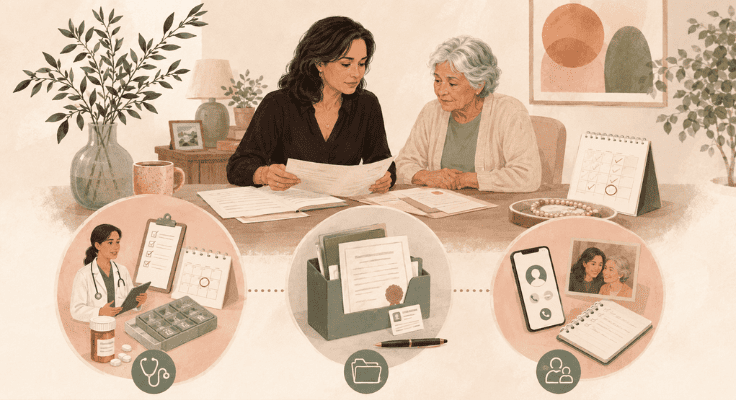
How to Start Caring for Your Elderly Parents
Once you've recognized that your parent needs support, the next step is building a foundation — informational, medical, and legal — before a crisis forces decisions to be made under pressure.
Go to Doctor's Appointments
Ask to accompany your parent to their next medical appointment. This single step often reveals more than months of phone calls: you'll hear directly what the doctor is concerned about, understand the medication list, and be able to ask questions your parent may not think to ask. Request that your parent sign a HIPAA release form so their doctors can speak with you directly going forward. If you can’t attend in person, request that their doctor contact you after the appointment to share about the visit.
Getting Your Parent on Board
Many parents resist help, not because they don't need it, but because accepting help can feel like losing independence. Frame conversations around partnership rather than takeover: "I want to help you stay independent longer" lands very differently than "You can't do this anymore." Involve your parent in every decision possible, and be patient — think of it as an ongoing dialogue rather than a one-conversation process.
It also helps to start small. Rather than proposing a complete overhaul of how your parent lives, offer to help with one specific task first — organizing pill bottles, setting up online bill pay, or accompanying them to a single appointment. Small wins build trust, and trust is what makes the bigger conversations (driving, finances, living arrangements) possible down the road. If your parent flatly refuses help and you're not dealing with an immediate safety risk, it's usually more effective to revisit the topic later than to push harder in the moment.
Get Your Documents in a Row
Before a health crisis hits, gather and organize:
Durable power of attorney (financial)
Healthcare power of attorney / healthcare proxy
Advance directive or living will
HIPAA authorization
Will and, if applicable, trust documents
List of medications, doctors, and insurance information
Login credentials for financial, medical and other accounts
Having these in place before they're urgently needed is one of the single most protective and proactive steps in caring for elderly parents.
Finding Solutions, Support, and Resources
You don't have to navigate this alone. Your local Area Agency on Aging, a geriatric care manager, a social worker at your parent's hospital or an eldercare-focused network can all connect you to home health services, meal delivery, transportation programs, and financial assistance you may not know exist.
Dealing With Dementia
A dementia diagnosis changes the caregiving trajectory significantly, often more than families expect at first. Early planning — legal documents, safety modifications, and a long-term care strategy — is even more critical, since your parent's ability to make and communicate decisions will decline over time.

How to Support an Elderly Parent in Need
Get Important Documents in Order
If you haven't already gathered the legal and financial documents outlined above, this is the moment. Store copies in a secure, shared location (digital and physical) that you and any co-caregiving siblings can access.
Ask an Occupational Therapist to Evaluate Your Loved One's Home
A home safety evaluation from an occupational therapist or an aging-in-place specialist can identify fall risks and recommend modifications — grab bars, raised toilet seats, better lighting, removing loose rugs — that let your parent stay safely in their home longer. Many of these evaluations are covered in part by Medicare when ordered by a physician, but familiarize yourself with your parent’s Medicare plan benefits and coverage first.
Think About Quality of Life: Theirs and Yours
Caring for elderly parents is not sustainable if it comes entirely at the expense of your own health, career, marriage, or finances. Quality-of-life planning has to be a two-way equation: what does your parent need to live well, and what do you need to keep caregiving without burning out? Building in respite and breaks, delegating tasks, and being honest about your limits, and your willingness, isn't selfish, it's what allows you to show up for the long haul.
This is often the hardest mindset shift for high-achieving women, who are used to solving problems through sheer effort and have a hard time asking for help. Caregiving doesn't reward that approach the same way a career does — it rewards sustainability. Ask yourself regularly: is this plan something I can maintain for months or years, not just this week? If the answer is no, that's information, not failure. It's a signal to bring in more support, whether that's a paid caregiver, a sibling taking on more, or a support group that reminds you that you're not the only one carrying this.

How to Have the Conversation With Elderly Parents
There's no perfect script, but a few principles make these conversations go better:
Choose the right time and place. A calm, private setting works better than a rushed moment during a family gathering.
Lead with love, not logistics. Start from concern and connection, not a list of problems.
Ask specific questions instead of issuing directives. "How do you feel about managing the stairs these days?" invites dialogue; "You need to move" shuts it down.
Expect resistance, and don't take it personally. Denial is often a fear response, not a rejection of you.
Break it into multiple conversations. Major decisions rarely get resolved in one sitting. Approach these as an ongoing dialogue, and plan to revisit the topics over time.
Bring in a neutral third party if needed. A doctor, social worker, or trusted family friend can sometimes deliver a message more effectively than an adult child can.

What Are the Living Situation Options for Elderly Parents?
Supporting Aging in Place
Aging in place — staying in one's own home with the right supports — is the option most older adults prefer. It can be made viable through home modifications, in-home care aides, meal delivery, transportation services, and medical alert systems.
Success with aging in place usually comes down to layering the right supports rather than relying on any single solution. A parent might need a combination of a weekly housekeeper, a medical alert pendant, grocery or meal delivery, a part-time home health aide, and a family check-in schedule. Reassess this combination every few months, since needs in eldercare tend to shift gradually and then suddenly — a fall, a diagnosis, or a hospitalization can change what's realistic almost overnight.
Home Care
For many families, professional in-home care — whether a few hours a week or around-the-clock — bridges the gap between full independence and a move to senior living.
Top Tips for Caring for Elderly Parents at Home
Start with a professional needs assessment rather than guessing at services.
Build a care team early, including backup professional caregivers for emergencies.
Use technology — medication reminders, fall-detection devices, shared calendars — to reduce the mental load.
Keep a shared document of medications, appointments, and care notes accessible to all family caregivers.
Schedule regular breaks for yourself before you're depleted, not after.
Revisit the care plan regularly, since needs in eldercare change often and quickly.
When Home Care Is Too Much to Handle
Watch for warning signs that home care has become unsustainable: your parent's needs now include tasks beyond what you or hired aides can safely manage (like two-person transfers or overnight medical monitoring), your own health or work is suffering significantly, or safety incidents are increasing despite precautions in place.
Using Respite Care Services
Respite care provides short-term relief for family caregivers, whether that's a few hours a week or a longer stay in a licensed facility. Respite isn't a luxury; it's a maintenance tool that helps prevent caregiver burnout and keeps your caregiving arrangement sustainable. Options range from in-home respite aides and adult day programs to short-term stays at assisted living or skilled nursing facilities, which can be especially useful if you need to travel for work or simply need an uninterrupted weekend to recharge.
Moving to Senior Living or Long-Term Care
When a parent's needs exceed what home-based care can safely provide, senior living communities — independent living, assisted living, memory care, or skilled nursing — become worth exploring.
How to Find a Quality Senior Living Community
Tour multiple facilities in person, ideally unannounced as well as scheduled
Check state inspection reports and licensing history
Ask about staff-to-resident ratios and staff turnover
Observe how staff interact with current residents
Review the facility's approach to medical emergencies and communication with families
Talk to current residents' families if possible
What to Do When Your Aging Parents Need More Care Than You Can Provide
When caregiving needs outpace what's realistic for your family to provide, it's time to loop in a geriatric care manager, social worker or their doctor to reassess the plan. This might mean increasing paid home care hours, exploring adult day programs, or transitioning to a senior living community. Again, recognizing these shifts and taking next steps is part of responsibly caring for elderly parents, and responsibly caring for yourself, over the long term.

Finding Caregiver Support
You are not meant to do this alone. Caregiver support groups (in-person and online), individual or family therapy, employee assistance programs through your employer, and eldercare-focused communities built specifically for professional women can all provide both practical guidance and emotional relief. If you have siblings, consider a formal division of responsibilities — even a simple shared spreadsheet outlining who handles appointments, finances, and day-to-day check-ins can prevent one person from quietly absorbing the bulk of the load.
For a more comprehensive support system, Living Goldenwell offers guidance and programming built specifically for women navigating this exact stage of life. Rather than piecing together generic caregiving advice, Living Goldenwell brings together resources, community, and structured support designed around the realities of being a professional or entrepreneurial woman while caring for elderly parents, so you have somewhere to turn and lean on that understands both sides of what you're carrying.

Identifying As A Caregiver
If you're a professional or entrepreneurial woman supporting an aging parent, chances are you don't think of yourself as a "caregiver" at all. You think of yourself as a daughter who's picking up prescriptions, managing a few extra phone calls, and keeping an eye on things. That instinct to minimize the role is common, and understandable — the word "caregiver" can feel like it belongs to someone else, someone with a more formal or full-time responsibility than what you're doing.
But by definition, a family caregiver is simply someone who provides unpaid care and support to a relative — help with medical needs, daily tasks, emotional support, financial management, or coordination of care — because of illness, disability, or the effects of aging. If you're managing medications, attending doctor's appointments, handling paperwork, or simply making sure your parent is safe and supported, you meet that definition, whether or not it feels that way yet.
Recognizing yourself as a caregiver isn't about taking on a heavier label — it's about giving yourself access to the resources, community, and legitimacy that come with the title. Caregivers are eligible for specific support programs, tax considerations, workplace accommodations, and communities of people who understand exactly what you're navigating. Naming what you're doing is often the first step toward getting real support for it, and there's nothing but strength in claiming it.

Taking The Next Step
Caring for elderly parents is rarely a linear journey — it shifts as your parents' needs, your capacity, and your family's circumstances evolve. What stays constant is this: the earlier you build your knowledge, your documents, and your support system, the more choices you'll have, and your parent will have, when it matters most. It’s critical to get curious, get educated, and get involved. You just need to take a next step, and then the one after that.
Take a few empowered steps forward:
 | Review and work through the Complete Aging Parents Checklist, to help you spot red flags, assess what stage your parent is in, and begin getting clarity and direction. |
 | Consider becoming a part of Caregiving From The Middle, Living Goldenwell’s leading connection network and learning space for women navigating eldercare and caring for elderly parents. Come gain your roadmap and support system, so you can have no regrets when all is said and done. |
Frequently Asked Questions
What Is the 40-70 Rule for Aging Parents?
The 40-70 rule is a general guideline suggesting that if you're 40 and your parents are around 70, it's time to start having proactive conversations about their future care, finances, and wishes — before a crisis forces those conversations to happen under pressure.
Is Taking Care of Elderly Parents Hard?
Yes — emotionally, physically, and logistically. Most caregivers describe it as one of the most demanding roles they've taken on, especially while also managing careers and their own families, which is exactly why building support systems and boundaries early matters so much.
Is There a Program That Pays You to Take Care of Your Elderly Parents?
Some states offer Medicaid-funded programs (often called "consumer-directed" or "self-directed" care programs) that allow eligible seniors to hire family members as paid caregivers. Eligibility and structure vary significantly by state, so check with your state's Medicaid office or Area Agency on Aging.
How Can You Tell an Elderly Parent That They Can't Live Alone?
Approach the conversation with empathy and specifics rather than ultimatums — point to concrete incidents (a fall, a missed medication, a kitchen fire) and frame the change as a way to preserve their safety and independence, not remove it. Involving a doctor or care manager can help the message land with less resistance.
What Are the Responsibilities of Caring for Elderly Parents?
Responsibilities can include coordinating medical care, managing medications and finances, arranging transportation, ensuring proper nutrition, overseeing household safety, providing emotional support, and making decisions about living arrangements as needs evolve.
What Are the Signs That My Elderly Parents Need More Help at Home?
Common signs include mismanaged medications, poor hygiene, an unkempt home, financial confusion, difficulty driving, poor nutrition, mood changes, memory lapses, mobility difficulties, and an increase in unexplained injuries.
What Resources Are Available to Help With Caring for Elderly Parents?
Area Agencies on Aging, geriatric care managers, local caregiver support groups, eldercare-focused communities and networks for women, home health agencies, and your parent's primary care team are all valuable starting points for eldercare resources and guidance.
What Are the Best Ways to Manage Stress While Caring for Elderly Parents?
Prioritize regular breaks, join a caregiver support group, connect with like-minded people navigating similar circumstances, set clear boundaries around what you can and cannot take on, delegate tasks to siblings or paid help where possible, and consider therapy, counseling or coaching-based support designed for women navigating eldercare.
What Are the Legal Considerations When Caring for Elderly Parents?
Key legal documents include a durable power of attorney, healthcare power of attorney, advance directive, HIPAA authorization, and an up-to-date will. Establishing these early, while your parent can still participate in decisions, prevents significant complications later.
What Are the Challenges of Caring for Elderly Parents?
Common challenges include balancing caregiving with career and family obligations, financial strain, emotional exhaustion, navigating a parent's resistance to help, coordinating care among siblings, and making difficult decisions about living arrangements and end-of-life care. For working women in particular, an added challenge is the near-constant task-switching between professional responsibilities and caregiving logistics, which can be mentally exhausting even on days without a crisis.
How to Balance Caring for Elderly Parents With Other Responsibilities?
Build a care team rather than trying to do everything yourself, use technology to streamline coordination, communicate clearly with your employer about flexibility needs, set firm boundaries, and schedule your own rest as non-negotiable, not optional.
What Are the Emotional Aspects of Caring for Elderly Parents?
Caregivers often experience a complex mix of love, guilt, grief, resentment, and anxiety — sometimes all at the same time. Anticipatory grief, watching a parent's decline, and role reversal between parent and child are especially common emotional experiences worth acknowledging rather than suppressing. Many daughters also describe a quiet identity shift, as the relationship with a parent moves from being cared for to being the one who cares, a transition that deserves emotional support in its own right, not just logistical solutions.
How to Communicate Effectively With Elderly Parents?
Speak clearly and directly, ask open-ended questions rather than making assumptions, give your parent time to process and respond, avoid talking down to them, and involve them in decisions about their own care whenever possible.