Why Caring for Older Parents at Home Isn't as Easy as You Think
Listen to the full audio here:
Watch the video summary here:

Table of Contents
The Reality Behind Caring for Elderly Parents at Home
The Overlooked Truth: Caring For Older Parents Changes Who You Are
You pictured it as an extension of love: a parent who raised you, now needing you back. What you didn't picture was the spreadsheet of medications, the phone calls, or the quiet resentment creeping in between work commitments and doctor's appointments. For the growing number of professional and entrepreneurial women navigating both a career and an aging parent's needs, caring for older parents at home is rarely the tidy, gratitude-filled experience it's made out to be. It's a second, unpaid job with no job description—and almost no one warns you how much it will reshape your identity, your finances, and your relationships.

The Reality Behind Caring for Elderly Parents at Home
Most conversations about eldercare focus on logistics: medication schedules, home modifications, hiring help. Those matter. But the deeper truth is that caring for older parents at home is fundamentally a role reversal, and role reversals are psychologically disorienting. You are simultaneously the daughter seeking approval and the decision-maker overriding your parent's preferences "for their own good”. That tension doesn't resolve with a better caregiver app. It requires you to actively renegotiate the relationship—something few families do intentionally, and most do reactively, in crisis, if ever.
Essential Tips for Adult Children Supporting Aging Parents
Get legal documents in place before you need them. Power of attorney, healthcare proxy, and advance directives should be signed while your parent is still cognitively able to consent. Waiting until a crisis often means going to court instead, and has painful downstream impacts you never anticipated.
Build a support network, not a hero narrative. One adult child, usually a daughter, typically absorbs the bulk of elder caregiving, leading to burnout, resentment and intra-family tensions. Distribute tasks across siblings, hired help, and local resources early on, even if it feels easier to "just do it yourself."
Track your own hours and costs. Family caregivers routinely and significantly underestimate what they're spending in time, energy and money until it's already jeopardized their retirement savings or career trajectory.
Separate medical administration from the relationship. Managing pills and doctor visits is not the same as maintaining a warm emotional connection. Protect time that isn't task-oriented so the relationship stays at the forefront.
Research eldercare resources before you're desperate. This goes for your parents as well as yourself. Know the senior care services available for older adults and also familiarize yourself with the types of guidance that will directly support you, so your wellbeing remains at the forefront.
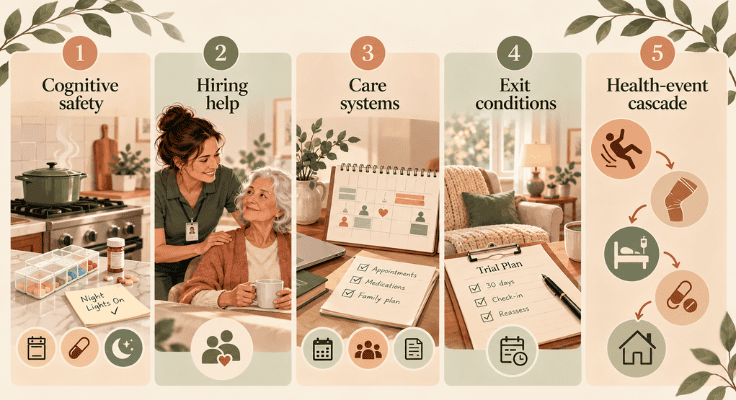
Short-Term Considerations Most People Never Consider
Home safety gets evaluated for mobility, not cognition. Grab bars and ramps address fall risk, but families rarely scan for cognitive risk—medication mix-ups, a stove left on, nighttime disorientation. While it's tempting to wait, since delaying home modifications saves money now, both fall and cognitive incidents typically happen before families believe either is likely, so changes usually get made mid-crisis instead of proactively. Reactive renovations cost more and happen during a crisis rather than a calm planning window.
Hiring help feels like giving up. Many women delay paid caregivers because it feels like admitting failure. While doing it all yourself can help you feel more in control and like you're saving money, caregiver burnout is one of the most under-diagnosed health risks among midlife women, eroding the quality of care you can give to yourself.
"Just for now" arrangements skip the systems elder caregiving needs. When a parent moves in temporarily, families skip a shared calendar, a designated medical point person, or a decision-making agreement, since setting all that up feels like unnecessary effort for something short-term. But temporary becomes permanent far more often than expected, leaving everyone improvising indefinitely when there's no systems or plan in place.
Parents rarely self-report how bad things actually are. Many minimize pain or confusion to avoid feeling like a burden. Taking their word for it respects their autonomy, but adult children who calibrate their concern to what a parent says are usually working with an undercount, resulting in silence getting mistaken for stability. Knowing signs and signals is an important part of effectively caring for an older parent at home.
Care coordination is treated as an afterthought, not a job. Families plan for appointments and prescriptions, not the invisible labor of syncing specialists or disputing insurance denials. Not tackling organizing this layer makes the early days feel less daunting, but it often ends up consuming more hours than hands-on care itself.
"Trial" living arrangements rarely have a defined exit condition. When a parent moves in "to see how it goes," families seldom agree upfront on what "not working" would look like, which sidesteps a hard and critical conversation early on. Without a trigger to revisit the decision, a poor fit can quietly drag on for a year or more.
A single health event is rarely contained. A fall leads to a hospital stay, then delirium, then a care-level recommendation no one saw coming - all within weeks. Not over-preparing for a cascade that may never happen can help keep early anxiety in check, but it also means families typically only account for "the fall" itself, not for everything else it can trigger.

Long-Term Considerations That Rarely Get Discussed
The financial trajectory compounds quietly. Short-term, out-of-pocket caregiving costs feel manageable. Long-term, they can total hundreds of thousands of dollars and directly reduce a family caregiver's own financial independence and retirement savings, a cost that's almost never modeled until it's already happened.
Your career narrative changes whether you plan for it or not. One benefit of stepping back professionally to care for an older parent at home is increased presence and peace of mind. But seriously consider the longer-term costs that may not be obvious right now: reduced income, paused or slowed advancement, and a re-entry gap that's complicated to explain in a resume. If figuring out your path to balancing both because both are important to you, we at Living Goldenwell provide guidance, tools and coaching for balancing your caregiving role with career.
Knowing the signs it's time to move an elderly parent to assisted living benefits everyone. This is the decision families avoid longest—and a transition families rarely address comprehensively. Warning signs include worsening falls, medication errors, social isolation, unsafe wandering, or caregiver health decline severe enough to compromise the care being given. The impacts of recognizing these signs early is tremendous: a planned transition instead of an emergency placement, more choice in facilities, and better outcomes for your parent's safety and dignity. Unfortunately, many families fear guilt, family conflict, and the perception of "giving up”. Reframing this decision as higher quality of life, safety, health and wellbeing for everyone involved rather than failure is a critical and important mindset shift when caring for elderly parents at home has run its course.

The Overlooked Truth: Caring For Older Parents Changes Who You Are
Here's what almost nothing on the internet says plainly: caring for older parents at home doesn't just add tasks to your life, it recalibrates your identity. Women who've spent decades building careers or businesses on competence and control often find eldercare humbling in an entirely different way, because there is no "winning" it, only navigating it well. The families who fare best and come out the other side with no regrets are the ones who treat elder caregiving as a strategic, evolving plan rather than a test of love and loyalty.
Get Support Before You Need It
You don't have to build this plan alone, and you don't have to wait for a crisis to start asking better questions. We at Living Goldenwell offer comprehensive guidance for women navigating the emotional, financial, and logistical complexity of eldercare, so you can make confident decisions instead of reactive ones. Visit Living Goldenwell to explore resources and guidance built for women in exactly this stage of life.
Take a few empowered steps forward:
 | Review and work through the Complete Aging Parents Checklist, to help you spot red flags, assess what stage your parent is in, and begin getting clarity and direction. |
 | Consider becoming a part of Caregiving From The Middle, Living Goldenwell’s leading connection network and learning space for women navigating eldercare and caring for elderly parents. Come gain your roadmap and support system, so you can have no regrets when all is said and done. |
Frequently Asked Questions
What are the biggest challenges of caring for older parents at home?
The most common challenges include financial strain, caregiver burnout, role reversal within the family, and the difficulty of balancing a career with eldercare responsibilities.
How do I know if I should hire help for caring for elderly parents?
If caregiving tasks are affecting your health, relationships, work performance, or ability to provide emotionally present care, it's a strong signal that outside support, whether part-time or full-time, should be part of the plan.
What is eldercare, and what does it typically include?
Eldercare refers to the broad range of support services and care provided to aging adults, including medical management, personal care, household assistance, transportation, and emotional support.
What are the signs it's time to move an elderly parent to assisted living?
Key signs include frequent falls, medication mismanagement, unsafe behavior like wandering, worsening isolation, and caregiver health decline that compromises the quality of care being provided at home.
How can I financially prepare for caring for elderly parents at home?
Start by documenting current and projected costs, exploring long-term care insurance or benefits your parent may already have, and consulting a financial planner familiar with eldercare and versed in long-term care financial planning to avoid depleting your own retirement savings.
Is it normal to feel guilty about eldercare decisions?
Yes. Guilt is one of the most common emotions reported by adult children caring for aging parents, particularly when considering options like hired help or assisted living. Recognizing and accepting this as a normal part of the process, rather than a sign of failure, is essential to making sound decisions for yourself and those you care about.